
 French

Document
2200 Result(s)
| Filtré par : Livre
Photobiogeochemistry of organic matter : principles and practices in water environments
Notice: Undefined property: stdClass::$Categories in /srv/www/limbgallery/current/public/themes/ENSSMAL_2/page-records/page-listing.php on line 190
Notice: Trying to get property 'title' of non-object in /srv/www/limbgallery/current/public/themes/ENSSMAL_2/page-records/page-listing.php on line 190
Photoinduced processes, caused by natural sunlight, are key functions for sustaining all living organisms through production and transformation of organic matter (OM) in the biosphere. Production of hydrogen peroxide (H2O2) from OM is a primary step of photoinduced processes, because H2O, acts as strong reductant and oxidant It is potentially important in many aquatic reactions, also in association with photosynthesis. Allochthonous and autochthonous dissolved organic matter (DOM) can be involved into several photoinduced or biological processes. DOM subsequently undergoes several physical, chemical, photoinduced and biological processes, which can be affected by global wanning. This book is uniquely structured to overview some vital issues, such as: DOM; HA and ROOH; HO'; Degradation of DOM; CDOM, FDOM; Photosynthesis; Chlorophyll; Metal complexation, and Global warming, as well as their mutual interrelationships, based on updated scientific results.
Ecological comparisons of sedimentary shores
Notice: Undefined property: stdClass::$Categories in /srv/www/limbgallery/current/public/themes/ENSSMAL_2/page-records/page-listing.php on line 190
Notice: Trying to get property 'title' of non-object in /srv/www/limbgallery/current/public/themes/ENSSMAL_2/page-records/page-listing.php on line 190
Sedimentary coasts with their unique forms of life and productive ecosystems belong to the most threatened part of the biosphere.
This volume analyzes and compares ecological structures and processes at sandy beaches tidal mudflats and in shallow coastal waters all around the world. Analyses of local processes are paired with comparison between distant shores, across latitudinal gradients or between separate bio-geographic provinces. Emphasis is given to suspension feeders in coastal mud and sand, to biogenic stabilization and disturbances in coastal sediment, to sea grass beds and faunal assemblages across latitudes and oceans, to recovery dynamics communities, shorebird predation, and to experimental approaches to the biota of sedimentary shores.
Wetlands and lakes of the world
Notice: Undefined property: stdClass::$Categories in /srv/www/limbgallery/current/public/themes/ENSSMAL_2/page-records/page-listing.php on line 190
Notice: Trying to get property 'title' of non-object in /srv/www/limbgallery/current/public/themes/ENSSMAL_2/page-records/page-listing.php on line 190
The occurrence and description of wetlands in India with reference to those around the world is detailed in a sequential manner from local, provincial, regional, and national to global scenario in this book, wetlands and lakes of the world. The book also deals with a systematic, sequential and comprehensive treatment of the Limnology (physico-chemical and biological features) and fisheries of the wetlands in India and is well supported by author's original data. As Limnology and Fishery science are interlinked, this book attempts to provide a holistic view of both the fields, along with their methodologies. The book has numerous examples from the local environment that go along with the explained theoretical concepts. Furthermore, a unique feature of the book is that it deals with the protocols of various Limnological methodologies, thus, making it a handy guide for lab and field studies. The book has distinguished itself by incorporating chapter based on global information system or GIS. The book also has an up to date bibliography and summary at the end of each chapter with text on various aspects, particularly, generally not much dealt with aspects like fisherfolk, their fish catching devices, fishing centers, fish markets and, above all, their socio-economic conditions supported by author's original data.
Conservation of genetic resources : costs and implications for a sustainable utilization of plant genetic resources for food and agriculture
Notice: Undefined property: stdClass::$Categories in /srv/www/limbgallery/current/public/themes/ENSSMAL_2/page-records/page-listing.php on line 190
Notice: Trying to get property 'title' of non-object in /srv/www/limbgallery/current/public/themes/ENSSMAL_2/page-records/page-listing.php on line 190
Bibliogr. p. 225-239; Index p. 241-243
Wastewater treatment : biological and chemical processes
Notice: Undefined property: stdClass::$Categories in /srv/www/limbgallery/current/public/themes/ENSSMAL_2/page-records/page-listing.php on line 190
Notice: Trying to get property 'title' of non-object in /srv/www/limbgallery/current/public/themes/ENSSMAL_2/page-records/page-listing.php on line 190
Wastewater flows are not steady or uniform, but vary from one hour to another, from day to day, from month to month and from year to year. When building a treatment plant, it is important to know the volumes of wastewater and their variations, now as well as in future. Based on the knowledge of the wastewater, the design of the treatment plant can be determined, taking into account the wastewater to be treated. In this connection measurements are useful; if such measurements do not exist, an estimate should be made. In respect of the volume of future wastewater, the development should of course be taken into account, i.e. a prognosis should be made.
Measurements of the volume of wastewater will be either in the form of curves or in the form of figures (metering). Fig 1.1 shows a diurnal variation for wastewater in the influent entering a treatment plant. The curve is the sum of domestic, industrial and public institution wastewater, infiltration and ex-filtration. There is no reason to consider the size of the individual contributions as the curve shows what reaches the treatment plant. In case of a projection of the volumes of wastewater and their variations, however, it is recommended to analyze the curve and the catchment area for the purpose of splitting up the sub-contributions as it will be easier to project these separately This is briefly dealt with in Sections 1.2 a By processing the data statistically a more detailed picture of wastewater variations is obtained. The different volumes of water (volume, maximum hour, maximum second, etc. over a 24-hour period) will often be normally distributed or log-normally distributed. Data sets for wastewater are never ideal as there will be irregularities which may, if they are too excessive, result in a special treatment of the data.
Fractile diagrams can be an important tool in the design of treatment plants. Fig 1.2 gives an example of such a diagram. The 60 per cent fractile is frequently used as an average load and a fractile of 85-90 per cent as a maximum load.
Aquatic ecosystem : biodiversity, ecology and conservation
Notice: Undefined property: stdClass::$Categories in /srv/www/limbgallery/current/public/themes/ENSSMAL_2/page-records/page-listing.php on line 190
Notice: Trying to get property 'title' of non-object in /srv/www/limbgallery/current/public/themes/ENSSMAL_2/page-records/page-listing.php on line 190
This book brings together the latest information on the rapid advances and developments in the field of aquatic ecology. India is very rich in terms of biological diversity due-to its wide range of habitats and climatic conditions. It is home to as much as 7 per cent of the world's animal species, although it only accounts for about 2 per cent of the total landmass. The present work on biodiversity, ecology and conservation of aquatic resources represents original research in the field of aquatic biodiversity, wetland ecology and its applications with reference to the country's aquatic resources. There are 19 chapters, each contributed by an expert in his/her particular field and offering novel approaches to various topics in the area of aquatic ecosystems.
Marine Productivity : perturbations and Resilience of Socio-ecosystems: proceedings of the 15th French-japanese oceanography symposium
Notice: Undefined property: stdClass::$Categories in /srv/www/limbgallery/current/public/themes/ENSSMAL_2/page-records/page-listing.php on line 190
Notice: Trying to get property 'title' of non-object in /srv/www/limbgallery/current/public/themes/ENSSMAL_2/page-records/page-listing.php on line 190
The 15th Franco-Japanese Symposium ofOceanography "Marine Productivity,Perturbations and Resilience of Socio-Ecosystems," organized by the long-standing partners Société franco-japonaise d'Océanographie de France and Société franco-japonaise d'Océanographie du Japon, reviewed the impacts ofnatural (storms, typhoons, earthquakes, tsunamis, etc.) and man-made (pollution, buildings in coastal areas, aquaculture, tourism, sports, diving, etc.)perturbations inflicted on coastal and marineenvironments. The Symposium examined theresilience of affected socio-ecosystems along with governance responses for these global/local environments. This book collects 43 selected papers, written by experts from numerous universities and research institutes in both countries. It addresses the needs of marinesciences researchers (natural and social sciences), decision-makers and coastal zone managers, and other stakeholders involved in coastal and marinesocio-ecosystems
The 15th Franco-Japanese Symposium ofOceanography "Marine Productivity,Perturbations and Resilience of Socio-Ecosystems," organized by the long-standing partners Société franco-japonaise d'Océanographie de France and Société franco-japonaise d'Océanographie du Japon, reviewed the impacts ofnatural (storms, typhoons, earthquakes, tsunamis, etc.) and man-made (pollution, buildings in coastal areas, aquaculture, tourism, sports, diving, etc.)perturbations inflicted on coastal and marineenvironments. The Symposium examined theresilience of affected socio-ecosystems along with governance responses for these global/local environments. This book collects 43 selected papers, written by experts from numerous universities and research institutes in both countries. It addresses the needs of marinesciences researchers (natural and social sciences), decision-makers and coastal zone managers, and other stakeholders involved in coastal and marinesocio-ecosystems
Governability of fisheries and aquaculture : theory and applications
Notice: Undefined property: stdClass::$Categories in /srv/www/limbgallery/current/public/themes/ENSSMAL_2/page-records/page-listing.php on line 190
Notice: Trying to get property 'title' of non-object in /srv/www/limbgallery/current/public/themes/ENSSMAL_2/page-records/page-listing.php on line 190
Following in the footsteps of the book Fish for Life - Interactive Governance for Fisheries (Kooirnan et al., 2005), and the interdisciplinary approach it presents, this volume illustrates the contribution of interactive governance theory to understanding core fisheries and aquaculture challenges. These challenges are invariably linked to broader concerns such as ecosystem health, social justice, sustainable livelihoods and food security. The central concept in this perspective is governability - the varied capacity to govern fisheries and aquaculture systems sustainably. Many of these systems are characterized by problems that are inherently'wicked' and therefore difficult to address. The authors of this edited volume argue that responses to such problems must consider context; specifically the character of the fisheries and aquaculture systems themselves, their institutional conditions, and the internal and external interactions that affect them. Drawing on a diverse set of international experiences, the volume offers a new lens and systematic approach to analysing the nature of governance problems and opportunities in fisheries and aquaculture, exploring pressing challenges and identifying potential solutions.
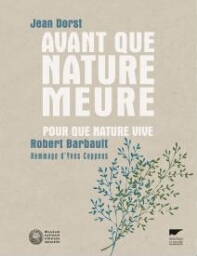
Avant que nature meure : pour une écologie politique, pour que nature vive
Notice: Undefined property: stdClass::$Categories in /srv/www/limbgallery/current/public/themes/ENSSMAL_2/page-records/page-listing.php on line 190
Notice: Trying to get property 'title' of non-object in /srv/www/limbgallery/current/public/themes/ENSSMAL_2/page-records/page-listing.php on line 190
Cette synthèse, qui prolonge le récit écologique de Jean Dorst en
s’appuyant tant sur des faits nouveaux que sur ses analyses d’une étonnante
clairvoyance, se développera en trois temps.
D’abord, je ne pourrai que confirmer la réalité de la crise d’extinction
annoncée et son interprétation : le tissu vivant de la planète se déchire,
symptôme aigu de ce que Jean Dorst appelait « le déséquilibre du monde
moderne ». Le réchauffement climatique, nouveau venu sur la scène depuis
1965, ne fait qu’aggraver la situation.
Ensuite, façon d’entretenir un espoir justifié, j’évoquerai l’ampleur de
la mobilisation qui a commencé à se déployer à partir des années 1970,
attestant d’une certaine manière que l’appel de Jean Dorst avait fini par
être entendu.
Atlas: initiation aux cartes et aux coupes géologiques
Notice: Undefined property: stdClass::$Categories in /srv/www/limbgallery/current/public/themes/ENSSMAL_2/page-records/page-listing.php on line 190
Notice: Trying to get property 'title' of non-object in /srv/www/limbgallery/current/public/themes/ENSSMAL_2/page-records/page-listing.php on line 190
Cet atlas est destiné principalement aux étudiants en licence de sciences de la vie et de la terre. L'ouvrage intéressera également les candidats aux concours (capes agrégation) ainsi que les élèves des filières BCPST.
La carte géologique est le document indispensable que tout géologue doit savoir utiliser. En effet, apprendre à lire une carte géologique permet de réaliser un document essentiel : la coupe géologique, qui est une visualisation de la disposition des terrains et de leurs structures en profondeur.
Dans cet ouvrage, le lecteur trouvera les bases pour lire une carte géologique. Cette initiation à la reconnaissance des structures géologiques est mise en œuvre à l'aide de schémas et d'exemples simples.
Mais la particularité la plus importante de cet ouvrage est apportée par les 19 extraits de cartes géologiques en couleurs qui ont été choisis pour illustrer des structures typiques (failles, plis, chevauchements, chronologie...) dans différents types de terrains. Chaque extrait est accompagné d'une coupe géologique réalisée et interprétée d'après les seules données de la carte.
Pour cette nouvelle édition, un soin tout particulier a été apportée à la qualité graphique des cartes. Deux chapitres sur la télédétection et sur le commentaire de carte ainsi que trois nouveaux extraits de cartes géologiques ont été ajoutés.
Il contient: la carte topographique; la carte géologique; topographie et géologie; les principales structures géologiques; chronologie des événements géologiques; la télédétection en cartographie géologique; la coupe géologique; le commentaire de carte; études de cartes et coupes géologiques.
Photobiogeochemistry of organic matter : principles and practices in water environments
- Auteur
- Mostofa, Khan M.G, Yoshioka, M.Abdul mottalab, Vione, Davide
- Sujet
- Organic matter ; Photosynthesis ; Biogeochemical cycles ; Photobiogeochemistry
- Cote
- 572.435 MOS
- Date_TXT
- USA : Springer , 2013
- Type de document
- Livre
Ecological comparisons of sedimentary shores
- Auteur
- Reise, K
- Sujet
- Sédimentologie ; Ecosystèmes
- Cote
- 552.5 REI
- Date_TXT
- Berlin : Springer , 2000
- Type de document
- Livre
Wetlands and lakes of the world
- Auteur
- Kar, Devashish
- Sujet
- Marine sciences ; Life sciences ; Aquatic biology ; Wildlife management ; Freshwater & marine ecology
- Cote
- 628.112 KAR
- Date_TXT
- New Delhi : Springer , 2013
- Type de document
- Livre
Conservation of genetic resources : costs and implications for a sustainable utilization of plant genetic resources for food and agriculture
- Auteur
- Virchow, D.
- Sujet
- Conservation ; Génétique ; Ressources
- Cote
- 576.83 VIR
- Date_TXT
- Berlin : Springer , 1999
- Type de document
- Livre
Wastewater treatment : biological and chemical processes
- Auteur
- Mogens, Henze
- Sujet
- Traitement ; Analyse ; Eaux
- Cote
- 628.162 HEN
- Date_TXT
- New york : Springer , 1997
- Type de document
- Livre
Aquatic ecosystem : biodiversity, ecology and conservation
- Auteur
- Rawat, Mamta
- Sujet
- Ecologie des eaux ;Inde
- Cote
- 577.38 RAW
- Date_TXT
- New Delhi : Springer , 2015
- Type de document
- Livre
Marine Productivity : perturbations and Resilience of Socio-ecosystems: proceedings of the 15th French-japanese oceanography symposium
- Auteur
- Ceccaldi, Hubert-Jean, Hénocque, Yves, Koike, Yasuyuki
- Sujet
- Oceanography; Earth sciences ; Géologie ; Actes de congrès ; Coastal Sciences
- Cote
- 577.1 CEC
- Date_TXT
- New York : Springer , 2015
- Type de document
- Livre
Governability of fisheries and aquaculture : theory and applications
- Sujet
- Aquaculture ; Gestion des pêches ; Pêche
- Cote
- 639.2 BAV
- Date_TXT
- New York : Springer , 2013
- Type de document
- Livre
Avant que nature meure : pour une écologie politique, pour que nature vive
- Auteur
- Dorst, Jean, Barbault, Robert
- Sujet
- Nature -- Protection
Écologie humaine
Écologisme
Nature -- Effets de l'homme
- Cote
- 577.27 BAR
- Date_TXT
- Paris: Delachaux et Niestlé et Muséum national d’Histoire naturelle, 2012
- Type de document
- Livre
Atlas: initiation aux cartes et aux coupes géologiques
- Auteur
- Sorel, Denis, Pierre, Vergely
- Sujet
- Coupes géologiques; La carte géologique ; Topographie et géologie; Carte topographique
- Cote
- 551.022 SOR
- Date_TXT
- Paris: Dunod , 2010
- Type de document
- Livre