
 French

Permalien :
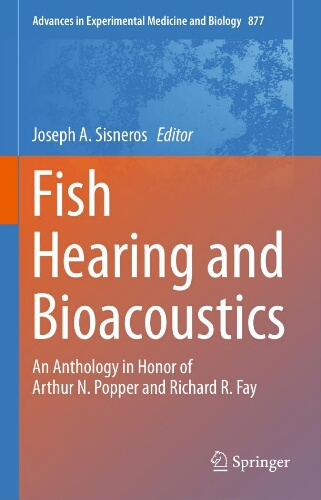
Fish hearing and bioacoustics : an anthology in honor of Arthur N. Popper and Richard R. Fay
- Date_TXT
- New York : Springer , 2016
- Cote
- 597.74 SIS
- Auteur
- Sisneros, Joseph A
- Type de document
- Livre
Description :
The book chapters that follow the biographies of Dick Fay and Art Popper are divided into three categories: acoustic communication and behavior, sensory biology and physiology, and morphology and neuroanatomy. The first chapter in Part II on acoustic communication and behavior is by Tim Tricas and Jackie Webb in which they review the current knowledge of sound producing mechanisms, hearing capabilities, and the likely importance of the auditory and lateral systems, especially the laterophysic connection, in acoustic communication in butterflyfishes. Jeffrey Zeyl and associates then present a review of sound production in darters, sculpin, and gobioids in a phylogenetic context that details the efficacy of signal transmission from senders to receivers and evaluates the potential functional significance of sound attributes in relation to reproductive and territorial behaviors. Next, Joe Sisneros and Pete Rogers summarize the previous behavioral work on directional hearing and sound source localization in fishes and review the current theoretical models for fish sound localization. Ashwin Bhandiwad and Joe Sisneros then review some of the common methods used in fish psychoacoustic studies and discuss associative methods such as operant, avoidance, and classical conditioning and how they are used to construct audiograms, measure frequency selectivity, and evaluate auditory stream segregation. They also present detailed considerations for experimental design with respect to stimulus presentation and threshold criteria and how these experimental variables can be used in future studies to investigate auditory perception in fishes. In Part III on sensory biology and physiology, Daphne Scares, Matthew Niemiller, and Dennis Higgs review the current knowledge on cavefish hearing, which has not been well studied, as hearing ability has only been examined in four species. These authors summarize their own studies on amblyop-sid cavefishes and offer suggestions for future research on these fascinating fishes. In the next chapter, Peggy Edds-Walton summarizes her research completed during collaborations with both Art Popper and Dick Fay on how the toadfish ear and central nervous system encode and process biologically relevant sounds and what we have learned about what the toadfish ear tells the toadfish brain specifically about the particle motion component of sound. Karen Maruska and Joe Sisneros then provide one of the first comparisons of auditory threshold curves determined by different recording methods in a single fish species, the soniferous Hawaiian sergeant fishAbudefdufabdominalis, and review past studies on representative fish species with tuning curves determined by different methods. Next, Dennis Higgs and Craig Radford examine the potential overlapping roles of the inner ear and the lateral line for encoding acoustic stimuli in the context of sound communication and other acoustically driven behaviors.